



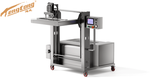

Belt Conveyor
What is Belt Conveyor
A belt conveyor is a system designed to transport or move physical items like materials, goods, even people from one point to another. Unlike other conveying means that employ chains, spirals, hydraulics, etc., belt conveyors will move the items using a belt. It involves a loop of a flexible material stretched between rollers that are actuated by an electrical motor. Because the items being transported vary in nature, the belt material also varies by the system it is employed in. It commonly comes as a polymer or a rubber belt.
Advantages of Belt Conveyor
Increased production efficiency: Belt conveyors provide a continuous transport system capable of handling large volumes of material without interruption. Compared with manual transportation, belt conveyors can significantly improve production efficiency, and save time and cost.
Reduce labor costs: Often exposed to hazardous work environments, and manual transportation can be a high-risk and labor-intensive job. The use of belt conveyors can mitigate these risks and reduce unnecessary labor costs, thereby reducing production expenses.
Reduced maintenance and downtime costs: Belt conveyors are relatively simple systems that require minimal maintenance. Belt conveyors are easier to maintain than other modes of transportation, helping to reduce equipment failure and downtime.
Energy Efficiency: Belt conveyors allow speed and power control, which can be adjusted according to production needs. By optimizing speed and power usage, belt conveyors reduce energy consumption, which reduces financial and environmental costs.


Why Choose US
One-stop solution
With rich experience and one-to-one service,we can help you choose products and answer technical questions.
Customization services
They provide customization services to meet specific customer requirements, ensuring that clients receive products that exactly fit their needs.
Innovation
We are dedicated to improving our systems continually, ensuring that the technology we offer is always cutting edge.
24h online service
We try and respond to all concerns within 24 hours and our teams are always at your disposal in case of any emergencies.
Types of Belt Conveyor
As the name suggests, the surface of this type of conveyor belt is made up of rollers that are selected to match production requirements, such as the weight or required speed of the products that will move along the belt. Shorter conveyor belts that fall under this type can be made up of just two rollers. However, as the distance between the two ends of the belt increases, more will be needed for the belt to function.
The flat belt conveyor belt is one of the most prevalent conveyor systems in use today. Flat belts are useful for internal conveyance, i.e. transporting items within a facility. This type of conveyor belt uses a series of powered pulleys to move a continuous flat belt, which can consist either of natural material or synthetic fabric (ex. polyester, nylon). Items are placed on top of the moving belt and carried from one end to the other.
While flat belt conveyors use a single, continuous loop of material, modular conveyor belt systems use a single loop made of countless interlocked pieces, usually made of hard plastic. These segments can be removed and replaced individually, in contrast to having to discard the entire belt. They're also easier to wash, as well as more resistant to sharp and abrasive materials. This makes modular belt conveyors simpler to maintain and repair than their flat belt counterparts.
Cleated belt conveyors feature vertical cleats or barriers in their designs. These cleats can keep loose materials secure during inclines and declines, to provide consistent spacing between items, and more. Furthermore, cleats come in different shapes, each with its own application.
Head Pulley
The head pulley is coupled with the actuator and the electric motor. It drives the conveyor, acting as the pulling force. The head pulley is located at the point that the conveyor offloads, known as the discharge end of a belt conveyor. Since it drives the whole system, it is often necessary to increase the traction of its belt with a rough jacket covering its outer surface. The jacket is referred to as a legging.
Return or Tail Pulley
This is located at the loading end of the belt conveyor. Sometimes it comes with a wing shape to clean the belt by letting material fall aside to the support members.
In a simple belt conveyor setup, the tail pulley will be mounted on guides usually slotted to allow the belt's tension. In other belt conveying systems as we shall see, tensioning of the belt is left to another roller called the take-up roller.
Idler Roller
These are rollers employed along the length of the belt to support the belt and load, prevent sagging, align the belt, and clean up the carryback (material left sticking on to the belt).
Idler rollers can either do all of the above or any one of them, but in any space, they will always act as support for the belt.
Conveyor Belt
In setting up a belt conveyor, the belt is perhaps the most intricate.The tension and strength are important since the belt takes a lot of punishment when loading and ferrying the material.
The growing demand for longer conveying lengths has catalyzed the research into new materials, though this always comes at a cost. Stronger belts that adhere strictly to environmentally friendly rules tend to come with high setup costs, sometimes the costs can hardly even be justifiable. On the other hand, if an economical approach is taken, the belt usually fails, resulting in high operating costs. Costs for the belt should usually range below 50% of the total cost for the belt conveyor.
Conveyor Frame
The frame, depending on the loading, height of operation, and distance to be covered will vary. They can come in a simple setup that can be represented by a cantilever. They can also be trusses in the case of larger loads. Extrusions of Aluminum are also employed for simple and lightweight operations.
Having two or more pulleys, a Belt Conveyor System consists of a belt expanded across the pulleys, forming a closed-loop for the continuous rotation to convey products or material from one point to another. One pulley, known as the drive pulley, usually contains a motor, drive or tows the belt in the same direction, results in moving items from one location to another. For the maximum utilization of the material handling conveyor belt, both the drive pulley and idler must rotate in the same direction, either clockwise or counterclockwise.

Uses for Belt Conveyor
Bulk Material Handling
Bulk conveyor belts are used to move a wide variety of products and raw materials, including sugar, oats, cereal, fruit, flour, screws, nut fasteners, and food nuts. They quickly and efficiently load and unload cement, sand, and gravel. In mining, coal, minerals, rocks, and stones are moved from open and closed pit mining operations. The varying lengths of conveyor belts make it possible to remove minerals and refuse.
Ship Loading and Unloading
Mobility is a crucial factor regarding the loading and unloading of ships. In the loading process, a belt conveying system unloads trucks and moves materials into the hold of a ship. For unloading, the process is reversed, and materials are moved from the ship and conveyed to trucks. Due to the unique nature of shipping and the different types of ships, loading and unloading belt conveyors are able to adjust to the height of the ship by telescoping.
Line Automated Assembly
Assembly operations have a series of conveyors that are custom-designed to fit the needs of the operation. As more and more assembly operations are using robotics and automated processes, belt conveying systems are being rapidly developed to meet the many computerized innovations and operational demands.
Luggage Transport
Belt conveyors are a necessary part of all airport operations in order to provide fast and efficient movement of packages, cargo, and luggage. For a belt conveying system to be successfully integrated into airport material handling, it must be able to meet the needs of all other handling and checking systems.
Parts Belt Conveyors
Parts belt conveyors can move and transport any type of part regardless of size or design, including hot, oily, and pressed parts from forging machines that need to be loaded in hoppers, storage units, and drums. Piano hinges are used due to their durability, strength, and rigidity. In addition, the weight and density of the part loads necessitate that the belt is made of shock- and impact-resistant materials, with sidewalls to prevent part spillage.
Excavation Belt Conveyors
Excavation belt conveyors are designed to move earth and materials through small enclosed spaces such as windows, doors, and vents. Belt buckets are designed to handle loads of varying weights and have a high load capacity. Though excavation belt conveyors are capable of handling heavy loads, they can be easily maneuvered and positioned by two or three workers.

Conveyor systems remain popular due to their time and labor saving benefits. The manual handling of materials reduces when using a conveyor system. As a result, much more efficient transport of large volumes of goods is achieved, allowing for higher volumes to be processed.
The use of conveyors is also space efficient, as less space and personnel is needed to move the items. As a result transporting products between stations in production and processing lines is simple and efficient with a conveyor.
Some industries and businesses may require only part-time or occasional use of a belt conveyor. A landscaping company or builder for example may need to hire a belt conveyor to clear their worksite more efficiently.
The belt conveyor system is also very versatile and can transport a wide range of objects, of all shapes and sizes. It is generally less expensive than other conveyor systems. Conveyor belts are also useful in instances where the use of a roller conveyor system for example would be unsuitable due to items being too light, having irregular bottomed surfaces, or also being too small. Consequently, these items may not move, could slip, or even get stuck in the rollers.
The specification of the belt conveyor is normally dependent on the application, industry, and product type. Manufacturers of bespoke and custom belt conveyor systems will ask about what the end usage of the conveyor will be, this is to ensure the conveyor system is built to suit that application. Things you should consider include the maximum load capacity, the conveyor belt system speed, throughput, the frame material or shape, and also drive configuration.
As well as this the type of product or material to be conveyed must be considered. Conveyor belts for the food industry for example must be suitable for washdowns and disinfecting. These conveyors often have a blue belt material, to denote they are washdown suitable which is a requirement of food hygiene laws. The belt surface itself also needs to be resistant to scratches or damage, as that could harbour bacteria.
Another consideration for your belt conveyor supplier is static electricity, as conveyor belts can generate static as they travel around the pulleys. Where static sensitive components need to be conveyed, this could be harmful to the product. A conveyor belt manufactured with anti-static technology, for example conductive belting, or static control brushes solves this problem.
Some items may be sensitive to vibration, pressure, or could be hazardous materials. These should therefore be discussed with the conveyor manufacturer so they can counter risks, thus ensuring the conveyor designed is fit for purpose.
The environment the conveyor will be running in is also important as humidity or temperature can affect operation. Consequently the conveyor needs to meet certain specifications to be able to continue optimal performance.
What About Conveyor Safety
Conveyor systems have different safety requirements depending on the usage & environment. The belt conveyor manufacturer should ensure that any risks are properly accounted for, and any workplace safety regulations are also adhered to. Industrial belt conveyors should be fitted with start-stop buttons, they can also be set up with remote stops. They can also have belt sway switches, which will stop the conveyor if the belt loses alignment.
If the belt conveyor is moving at a speed other than what has been specified, a speed switch can stop the belt to ensure the users, products, and the belt itself do not become damaged. If the belt however does become damaged, a belt rip switch is triggered. Fitted guards ensure products remain on the conveyor system when moving goods on an incline.
Conveyor systems controls can be as simple as on and off, or soft-starts which cushion loads on start up. Variable frequency drives also control the speed and acceleration of the motors.

Types of Belt Conveyor Take-Ups
Screw Take-Up
The screw take-up configuration uses mechanical force to take up all the slack in the belt. It achieves it by adjusting a threaded rod that is attached to one of the rollers, especially the tail roller. This threaded rod will be on each side of the roller so it can also work as an alignment procedure. Since this is a hands-on manual approach, screw take-up is often called manual take-up.
Gravity Take-Up
Screw take-ups are usually not suited to lodge the length of the stretch that happens in conveyors longer than 100 meters. In these setups, gravity take-up will be the best approach to belt tensioning.
A gravity take-up assembly uses three rollers where two are bend rollers and the other one will be a gravity or sliding roller that routinely manages the belt tension. A counterweight that will be mounted to the gravity take-up roller pulls down on the belt to preserve tension through gravity. The bend rollers direct the belt slack around the gravity take-up roller.
The full take up assembly is integrated into the bottom of the conveyor frame and makes a continuous tension on the belt. This way of self-tensioning arrangement allows the take-up to easily adjust to sudden spikes in tension or load.
Horizontal Take-Up
The horizontal take-up is a substitute for gravity take-up but only when space is limited.
This take-up is similar to gravity take-up, but instead of the assembly being located below the belt, it is situated vertically behind the tail roller. This makes it especially beneficial when the conveyor is located on a grade that does not have any additional space under the conveyor.