



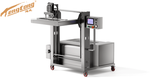

Commercial Vacuum Packaging Machine
What is Commercial Vacuum Packaging Machine
A reliable industrial vacuum sealer enables quick yet efficient vacuum packaging of medical products, such as disposable equipment, safely within a clean room environment for sanitary and bacteria-free delivery to hospitals and doctors alike. Likewise, our high-tech vacuum packaging offers aviation and automobile industrial manufacturers convenient storage and handling of delicate parts and components. Our programmable control panel allows storage of your products parameters setting for consistent packed result and seal quality.
Advantages of Commercial Vacuum Packaging Machine
Vacuum Food Sealers Save Your Time
Seal family-sized portions of meals or individual portions of snacks or vegetables and freeze. When it's time to eat, fix the portions you need and you're done. This is very useful and dinner is served very quickly.
Vacuum Sealers Save Your Money
Buying meats in bulk, dividing into meal-sized portions and sealing allows you to have fresh meat on hand for up to 6 months. This leads to an incredible cost savings over buying your meat from the counter before every meal.
Vacuum Sealing Protects Food
Vacuum sealing protects food from dehydration and freezer burn. Freezer burn occurs when water gets into your food. The vacuum bag keeps your food from contact with the air, so moisture cannot evaporate, making it an excellent barrier from the elements.
Vacuum Sealing Extends Shelf Life
The shelf life of your food is greatly extended when you vacuum seal it. Vacuum sealing food preserves it 3 to 5 times longer than food stored in plastic containers or bags. The exact amount of time food will last in vacuum sealing varies depending on whether you are storing in the refrigerator, freezer or pantry.
Efficient Food Organization
Vacuum sealing makes for efficient, organized packaging. Vacuum sealed food takes up less room in your refrigerator or freezer and allows you to easily see the foods you are storing.



Why Choose US
One-stop solution
With rich experience and one-to-one service,we can help you choose products and answer technical questions.
Customization services
They provide customization services to meet specific customer requirements, ensuring that clients receive products that exactly fit their needs.
Innovation
We are dedicated to improving our systems continually, ensuring that the technology we offer is always cutting edge.
24h online service
We try and respond to all concerns within 24 hours and our teams are always at your disposal in case of any emergencies.
Types of Industrial Vacuum Packaging Machine
Tabletop vacuum sealers are one of the types of vacuum sealing machines on the market today. They are the best choice for a production area with a flat table or surface. These machines are designed for sealing numerous packages and can meet light to heavy manufacturing needs. Not designed for any specific industry, the versatile tabletop machines can be used in electronics, aviation, medical, industrial, food and more. Tabletop machines can be outfitted with numerous options, but the chamber machines are perfect for food and restaurant needs with their handy wet-seal options. They are simple to operate, require little maintenance, and easy to keep clean. Their main advantage is they fit in compact spaces and come with a moderate price tag. If you are short on space and looking for a budget-friendly vacuum sealer, then a tabletop sealer is the perfect choice for you.
Mobile vacuum sealers are another of the types of vacuum sealing machines available. They are the best choice for a production area where simple machine relocation is a necessary part of production. Ergonomically designed for repeated use, the simple castors make their relocation a breeze. These machines are designed for sealing more than one package at a time and can meet light to heavy packaging demands. Not designed for any specific industry, mobile machines can be used in electronics, aviation, medical, industrial, food and more. They can be outfitted with numerous options, but the chamber machines are perfect for food and restaurant needs with their handy wet-seal ability. Along with their ergonomic design, they are simple to operate, require little maintenance, and easy to keep clean. If you are looking for a packaging machine to service more than one area of your production, then you should consider a mobile vacuum sealer.
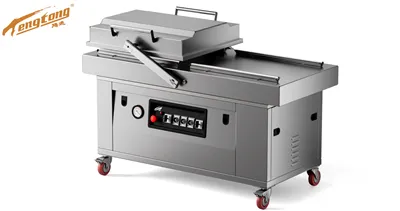
Double chamber vacuum sealers are the best choice when demand for production is not met by a single chamber machine. These machines also feature casters that allow for easy relocation. Their double chamber design allows for sealing more than one package at a time. An operator can meet heavy packaging demands by loading a new packaging while the machine is sealing the other. Not specific to any industry, double chamber machines are great for electronics, aviation, medical, industrial, food and more. Double chamber machines are also perfect for any wet seal needs in the food packing industry. Along with their ergonomic design, they are simple to operate, require little maintenance, and easy to keep clean. If you are looking for a high-output packaging machine, then a double chamber vacuum sealer is worth the investment.
Nozzle vacuum sealers are compact models that can easily fit on a small counter or table. Unlike chamber models, they can accommodate varying sizes of packages without many limitations. They provide a quicker vacuum cycle along with increased control. They can be foot operated or timed, and deliver high productivity with the ability to seal one or two packages at a time. Nozzle vacuum sealers are perfect for electronics, aviation, medical, industrial, food and more. They are a great choice for simple cleanup at the end of each day. This option works well if you have limited space to package products and provides an economic industrial choice. If you are looking for a high-output, versatile packaging machine, then a nozzle vacuum sealer is a great choice.
Components of A Vacuum Packaging Machine
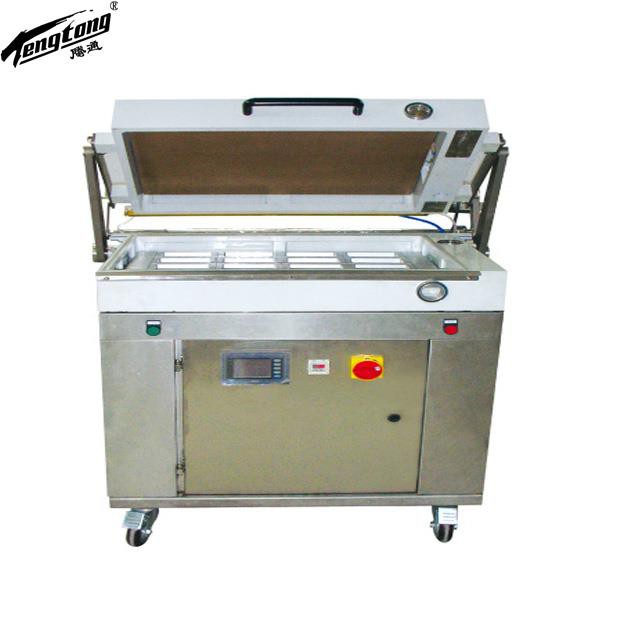
A vacuum packaging machine consists of key components that combine together and assist the stable functioning of packaging. Some of the major parts are
Main Frame
It is the main structure of machine made up of durable stainless steel. With organic glass covers (upper & lower cover) and compact structure it yields smooth stable performance while requiring effortless controlling.
Control Board
Another essential component of this machine is the control panel compromised of various keys for controlling temperature, fixing conveyor belts, sealing nozzle, and emergency stop etc. It provides soft touch interface for setting operational parameters.
Vacuum Room
It is the surface of machine where loaded container is placed for processing. It is like a room for your bags in which they are passed through complete procedure and portrayed as final output.
Vacuum Pump
It would not be wrong to say that vacuum pump is the boss of vacuum packaging machine whose main task is to reduce oxygen level present inside the food container through suction power. It effectively removes all the internal gases from bags ensuring long life for your products.
Universal caster
The universal movable casters are fitted beneath the vacuum packaging machine. These high quality wear-resistant wheels enable machine to rotate around 360 degree and are of great importance for easy handling and movement.
Sealing Frame
The actual and most significant task in a vacuum packaging machine is done by this key component. It is located above the machine surface which allows heated seal bar to join together the sides of plastic film.
Differentiate Between Various Types of Vacuum Packaging Machines
|
Factors |
Automatic Vacuum Packaging Machine |
Manual Vacuum Packaging machine |
|
Definition |
An automatic vacuum packaging machine pack various products through independent process without any error. |
This machine of manual character can be used to vacuum pack numerous items through manual intervention of an operator. |
|
Process |
The machine works automatically after the fixation of parameters. |
Timer for sucking air is settled untill desired level is achieved. |
|
Speed |
It is super fast as it does not require any timer rather functions through non stop process. |
Compare to automatic vacuum packaging machine it is slow because of process breakage by user. |
|
Application |
This machine is best suitable for hard stable items and mostly utilized by large industries. |
This equipment is best for soft products like muffins and is used by small scale factories. |
What Are the Common Faults and Possible Solutions While Using a Vacuum Packaging Machine
|
Faults |
Reasons |
Solutions |
|
Flatulence occurs and hot air left in vacuum bag |
Less number of vent holes Fast speed of conveyor belt |
Increase vent holes for quick air leakage from bag Reduce the conveyor belt speed and increase machine temperature to assist air exclusion from film |
|
The sealing line is weak and easily broken |
Incorrect height of sealing line Sealing tension is not uniform Short sealing time |
Adjust sealing line height by making it half of the height of packaging Adjust horizontal position of sealing frame Extend sealing time until the process is completed |
|
Surface of film is unclear and blurred |
Too high temperature which result in film shrinkage Low speed of conveyor belt |
Decrease temperature of machine Enhance the speed of conveyor belt so the time for film to contact heat would be less |
|
Cutting and sealing position error |
Circulating wind direction, conveyor belt height and sealing frame are incorrect Size of vacuum bag is too large |
Check them all and adjust to suitable position Reduce the size of packaging film |
|
Vacuum bag is sealed triangular at the corner |
The vacuum bag length is big Circulating wind and temperature of shrinking packaging machine is quite low |
Make the packaging bag smaller Adjust the speed of temperature and circulating wind as well |
Why Is Vacuum Sealing so Popular in Commercial Settings
Protective
First and foremost, vacuum packaging provides a protective, air-tight seal that locks out contaminants that could damage or spoil the product. This also prevents contamination of food and beverage products and helps extend the shelf life because vacuum sealing works by evacuating excess oxygen, which slows down the decomposition processes of perishable products. All of this benefits both the manufacturer and consumer by preventing, damage and loss of product while helping to ensure product quality.
Efficient
Another benefit of using fully automated vacuum sealing systems is that it makes the packaging process much more efficient. There are many high-speed vacuum packaging systems that can operate completely hands-free and produce 60 sealed units per minute. This helps increase production speed and output volume while removing the burden of tedious manual packaging efforts from your staff.
Affordable
Finally, many manufacturers and packaging facilities seek out fully automated vacuum packaging machinery because this equipment makes the packaging process overall more affordable. With the use of hands-free, vacuum sealers, facilities are able to reduce labor costs, increase productivity, and prevent damage to their products, resulting in a much more cost-effective packaging process.
Factors That Should Be Considered Before Purchasing a Vacuum Packaging Machine
Suction Power
One of your foremost considerations should be the suction power. The strong power suction can fastly remove oxygen and air from bag. Examine these features of machine and make sure whether or not the machine will provide successful packaging.
Packaging Speed
This aspect of a vacuum packaging machine is very essential to know if you are purchasing it for commercial use. Make sure that its capacity and efficiency of packaging is high. The quicker the machine seals the bags the more would be number of containers it can pack.
Reparability
Your next question should be about reparability. Ask for the easy maintenance, fixation of machine and the availability of parts in case of electrical error or part damage.
Power of Vacuum Pump
Among all other parts of machine vacuum pump is the heart. One should be aware of the power and quality of vacuum pump installed in a packaging machine. Its effective nature can ultimately enhance the production capacity of packaging.
Operational Requirements
The type of vacuum packaging machine would be definitely determined by the products you are going to pack. The size, nature and volume of materials play important role in the selection of suitable machine. For instance goods requiring more air to be removed need external vacuum sealer. While as, for sensitive items a chamber vacuum sealer is highly qualified.
Vacuum Packaging Machine Steps
Turn on the power Turn the power selection switch as needed, that is, the power indicator light is on. The power selection switch points to the vacuum for the vacuum seal, and the vacuum is directed to the vacuum charge seal.
Place the plastic bag containing the item in the vacuum chamber. The bag mouth is neatly placed on the heat seal (if at least one nozzle should be inserted into the bag mouth for the air-filled package).
Press down the cover and the air pumping (vacuum) indicator on the panel lights up. The vacuum pump starts pumping, the cover is automatically sucked, and the vacuum knob can adjust the vacuum level according to the packaging requirements. When adjusting, the scale is from low to high. The magnitude should be small.
When the pumping reaches the set time (ie the required degree of vacuum), that is, the pumping is over, the pumping indicator is off, and the charging indicator lights up to indicate the start of the inflating. The inflating knob can adjust the length of the inflating time (ie, inflating) How much?) The method is the same as above. If you do not need to inflate. Turn the power switch to the vacuum position, the program will automatically enter the vacuum packaging, and the inflation indicator will go out.
When the air pumping or inflation is completed, the indicator light will be extinguished, and the heat seal indicator light will be on, that is, the sealing procedure will be entered. The heat sealing time and temperature adjustment knob are arranged on the panel to adapt to different thickness materials, and when adjusting the time and temperature, the rotation is performed. The amplitude should be small to prevent the heat seal temperature from suddenly increasing and burn out the heat seal fittings.
When the set heat sealing time is reached, the heat seal indicator light is extinguished, so that the heat seal is finished, that is, the vacuum chamber enters the atmosphere through the solenoid valve until the cover is automatically lifted, and the vacuum inflation packaging process is completed, ready for the next time. Packaging cycle.