



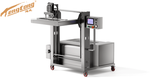

Roller Conveyor
What is Roller Conveyor
Roller conveyors are a series of rollers supported within a frame where objects can be moved either manually, by gravity, or by power. There is a wide range of ways roller conveyors can be used and modified for different uses including transporting boxes, cardboard boxes, crates, pallets, plastic totes, polybags, slave boards, and trays. Roller conveyors are normally used in environments such as warehouses or manufacturing facilities due to the nature of transporting goods.
Advantages of Roller Conveyor
Speed - Roller conveyors are a safe and fast transport system, which reduces the risk of damage to goods due to mishandling.
Reliability - One of the reasons for the continued use of roller conveyors is their reliability as a long lasting logistics solution.
Cost Effectiveness - Roller conveyors are long lasting due to their toughness and durability. The initial investment in their cost is amortized over their many years of use.
Efficiency - The speed at which roller conveyors can move goods enhances and improves material movement.
Maintenance - Roller conveyors require limited maintenance due to their simple design and few moving parts, which reduces material handling downtime.
Safety - The continued use of roller conveyors has significantly reduced injuries due to the removal of the need to lift and move products by hand. This is one of their main benefits since workers no longer need to lift heavy packages or containers, a process that can be completed using various lifting mechanisms.
Customizable - The versatility, structural flexibility, and conformability of roller conveyors makes it possible to place them in any space where product movement is required. Every roller conveyor has to be engineered to fit the conditions where it will be used.


Why Choose US
One-stop solution
With rich experience and one-to-one service,we can help you choose products and answer technical questions.
Customization services
They provide customization services to meet specific customer requirements, ensuring that clients receive products that exactly fit their needs.
Innovation
We are dedicated to improving our systems continually, ensuring that the technology we offer is always cutting edge.
24h online service
We try and respond to all concerns within 24 hours and our teams are always at your disposal in case of any emergencies.
Types of Roller Conveyor
Gravity Roller Conveyor
Gravity roller conveyors are the most basic form of roller conveyor and consist of a frame with rotating rollers, support legs, and the use of gravity to move materials. They transport light to medium weight loads and do not have a motor, which makes them the most cost effective material movement choice.
Belt Driven Live Roller Conveyor (BDLR)
Belt driven live roller conveyors have a motor that powers each roller with a motorized belt that allows for control of the movement of materials. Loads can be halted, turned and side unloaded or slide loaded, and reversed. The power driven belts of BDLR conveyors make it possible to move materials vertically and around curves. Some versions have a shaft that runs perpendicular to the rollers that positions and moves the belts that move the rollers.
Chain Driven Roller Conveyor
Chain driven roller conveyors are powered by a chain drive connected to each roller. The configuration of chain driven roller conveyors is different from a single chain driven roller conveyor that powers the rollers with one long chain. The rollers on a chain driven roller conveyor have sprockets attached to each roller that powers and turns the roller.
Power transfer is high in chain driven roller conveyors, which makes them suited for medium to heavy loads. As with other powered roller conveyors, the power on a chain driven roller conveyor can be reversed allowing movement of materials in both directions.
Line Shaft Roller Conveyor
Line shaft roller conveyors are driven by a rotating shaft that is attached to the rollers by drive spools and belts with one spool for each roller. The belts for each roller run from the shaft to the spool that turns the roller. When the shaft is powered, it turns the belts that turn the spools that turn the rollers.
A programmable logic controller (PLC) controls the electric motor that turns the shaft. With the absence of chains and sprockets, line shaft roller conveyors operate quietly and smoothly. The shaft runs the length of the roller conveyor and is placed below the rollers to one side of the frame.
Zero Pressure Roller Conveyor
With traditional accumulation conveyor systems, materials on the conveyor are allowed to bump into each other and stack up, a condition that creates pressure between materials that can damage the quality of products. In those types of conveying systems, material movement is uncontrolled and continues regardless of products being stopped and stationary.
Zero pressure roller conveyors or pressureless accumulating conveyors have zones driven by 24 volt DC motors controlled by photoelectric sensors. A central controller receives feedback from the sensors that lets it know if the zone ahead for a product has anything in it. If it does, the controller stops movement preventing the build up of back pressure.
Rollers
Rollers for roller conveyors are metal cylinders fitted into its frame with sets of bearings on either end of the cylinder. There are several types of conveyor rollers each of which is designed to fit the needs of the product being transported. Rubber and plastic rollers increase friction while steel and aluminum rollers have a smooth surface. Rollers are selected for their ability to keep products on the conveyor, and their ability to maintain the integrity of products.
Structure of a Roller Conveyor
The frames of roller conveyors can be permanently positioned or temporarily placed and are made of steel, stainless steel, or aluminum. The convenience of temporary roller conveyors makes it possible to assemble and disassemble them for repositioning. Of the choices of structural metals, aluminum roller conveyors are lighter and are used for moving lighter loads.
Roller Conveyor Motor
Roller conveyor motors are 24 volt DC motors that use less energy and have less torque, which makes them safer. A motorized roller conveyor is divided into zones with each zone having a motor driven roller (MDR) that is connected to the other rollers in the zone. The DC motors are built inside a roller in a zone and are controlled by an operator that determines the speed and direction of the movement of the conveyor.


Angular Contact Ball Bearings
Angular contact ball bearings make contact with the line of action of the load at an angle to the bearing's load. The inner and outer ring raceways of angular contact ball bearings are designed and developed to be positioned close to each other in the bearing axis' direction. This enables them to handle combined radial and axial loads. Types of angular contact ball bearings include single row, double row, and four point contact ball bearings.
Roller Conveyor Sprockets
Roller conveyor sprockets are gears that mesh with conveyor chains to transfer rotary motion to the rollers of a powered roller conveyor. The sizes of roller conveyor sprockets vary according to the number of teeth in their gears, power transmission, diameters, and the length of their bore. They can have plastic hubs, which are only used with light to medium loads. Steel hubs provide more strength and are able to handle heavier loads.
Roller Conveyor Curves
Roller conveyor curves are included in a roller conveyor system to change the direction and flow of materials without changing the orientation of the materials. They are designed to move items around corners, curves, and obstacles or equipment. Curve design is influenced by its angle, which needs to be at least 30° and no more than 90° with curve angles of more than 90° requiring special engineering.
Main Applications of Roller Conveyors in a Warehouse
Prepare preload channels
Roller conveyor channels are enabled in the goods dispatch area, especially when handling pallets. As a result, pallets are deposited in front of the loading bays by orders or routes. They are now ready to be loaded onto the trucks, usually with manual or electric handling equipment.
Have accumulation channels for unloading trucks
Goods reception processes vary greatly if they are for pallets or boxes and if the origin is a production facility or trucks. Conveyors are then used to deposit pallets waiting to be slotted or unpacked/unbundled. If working with boxes, another way of using roller conveyors is to build the circuit’s start point next to the docks.
Automatic loading and unloading
This operation can be carried out automatically thanks to a series of built-in chain conveyor platforms in the loading and unloading docks.
How Do Roller Conveyors Work
These systems are put into place to reduce inventory, lower handling costs, enhance customer service, and shorten delivery time. A roller conveyor is a highly popular conveyor belt that’s designed to allow objects to move along the surface with the use of rollers.
These rollers are equally spaced cylinders that revolve constantly while the conveyor is operational. Roller conveyor systems can transport items from one destination to another with small engines or gravity, which is an integral aspect of the material handling process. Once you’ve installed the right roller conveyor in your facility, you should notice efficiency improvements throughout the entire facility.
Types of Roller Conveyors Table with Characteristics and Usage
|
Type of Roller Conveyor |
Characteristics |
Usage |
|
Gravity Roller Conveyor |
– No power source required |
– Warehouses |
|
Powered Roller Conveyor |
– Uses electric motors |
– Packaging lines |
|
Accumulation Conveyor |
– Sections can be powered or non-powered |
– Sorting processes |
|
Chain-Driven Roller Conveyor |
– Uses chains to drive rollers |
– Heavy-duty applications |
|
Line Shaft Roller Conveyor |
– Uses a shaft beneath rollers for power |
– Lightweight applications |
|
Flexible Roller Conveyor |
– Adjustable and portable |
– Dynamic workplaces |
|
Pallet Roller Conveyor |
– Heavy-duty design |
– Transporting pallets |
|
Spiral Roller Conveyor |
– Vertical design |
– Multi-story facilities |
Applications of Roller Conveyors
Roller conveyors find their uses in a variety of sectors. Here’s a quick glance at some of their primary applications:
Warehousing and Distribution
Stock Rotation: Roller conveyors ensure smooth stock rotation, especially in large warehouses.
Loading & Unloading: Speeds up the process of loading and unloading trucks and containers.
Manufacturing
Assembly Lines: Products move through different stages of assembly seamlessly.
Packaging: Efficient movement of goods through packing zones.
Retail
Backroom Operations: Streamlining the process of moving stock to the retail floor.
Checkout Counters: Larger retail setups use roller conveyors for handling bulk purchases.
Considerations When Choosing Roller Conveyors
Available Space
Conveying system manufacturers consider the available space while designing a system. This step necessitates the identification of interaction sites, clearances, impediments, or any other areas that may impede material movement. Though automated systems are the most popular, whether the system is motorized or manual is determined by how it is used.
Roller Frame Material
The frame is often made of aluminum or steel, depending on the amount of loading on the system and the value of the rated frame's capacity. Rollers are substantially more variable in composition because they come into direct contact with products and can influence their movement. Some rollers are covered in plastic or rubber to increase friction, while others are just aluminum or steel drums. A properly selected roller keeps products on the line while not compromising its integrity.
Roller Sizer and Orientation
The size of the material on the conveyor, as well as the ideal layout of the conveyor, must be determined so that it does not impede the movement of products. Individual roller sizes are determined by the load and loading conditions. Heavy, high impact loads, for example, necessitate large rollers, whereas slow, low impact loads use smaller rollers.
Load Capacity
Once the system has been set out and given a pattern, the quantity of material it can carry must be established. Overloading a system can lead to malfunctions or work stoppages. The overall length, bed breadth, and drive system have an impact on load capacity. Gravity roller conveyors are ideal for flat-bottomed, light to medium weight goods like totes, boxes, and bags but cannot be used with extremely delicate and cumbersome geometries like electronics and manufacturing parts.
System Speed
A conveying system's speed is measured in feet per minute (fpm). The average speed of most conveying systems is 65 feet per minute, which is how fast a person walks when carrying a 50 pound load. Although this is average, the speed of a roller conveying system can be adjusted to suit the application.
Roller Conveying System Configuration
Roller conveying systems are available in a wide range of shapes, styles, sizes, and configurations. They might be straight, angled, horizontal, or curved with pockets or slats as well as z-frames. If hundreds of feet must be crossed, a more efficient design, such as a line shaft roller conveyor, should be considered as a means to conserve energy. Roller conveyors can be installed in any facility or structure as long as careful consideration is given to each of the factors related to its use.
Roller Conveyor Maintenance
Conveying systems are machines with interacting pieces that rely on one another to function properly. The various types of roller conveyors are pieces of equipment that necessitate a maintenance schedule to ensure proper performance. To effectively maintain a system and avoid problems, it is important to schedule regular examinations of a conveyor’s components that contribute to its overall performance.
Conveyor Maintenance Steps
The drive chain and sealed roller bearings must be oiled. Operators should be trained as to the proper inspection procedures in regard to bearings, rollers, shafts, belts, and DC motors.
Driver rollers need to be cleaned to avoid system blockages. Residue or debris collected during material movement must be wiped from the surface of the rollers. Cleaners used on rollers have to be products designed for the specific roller. Stainless steel rollers, for example, must be sprayed with water then washed with a detergent. Preventative maintenance can address minor issues before they become major ones and ensures proper equipment performance
Preventative Conveyor Maintenance
Preventative maintenance involves examining conveyor rollers for flexible and smooth movement, drive chain or belt wear, and how level rollers are. Rollers should move in one direction and the same direction. Wobbling or non-movement of rollers is an indication of a problem, which should be addressed immediately. Since bearings fail due to wear, they should be regularly checked.
As with any tool, roller conveyors that operate continuously endure wear and degradation due to the conditions of the environment where they are used. High temperatures and humid conditions have a negative effect on roller conveyors, which necessitates an increase in the number of times they should be examined. A key to the continued successful performance of a roller conveyor is intervals of downtime that allows the system to cool.